Grounded in established frameworks

Gestoa is grounded in the Eight Competencies of Public Speaking (UCCS), the NSA Professional Speaker Competency Model, and the Toastmasters Pathways five-level system. These are compressed into six independently trainable skill areas, and the level-up is made AI-measurable rather than human-judged: every threshold is a number.

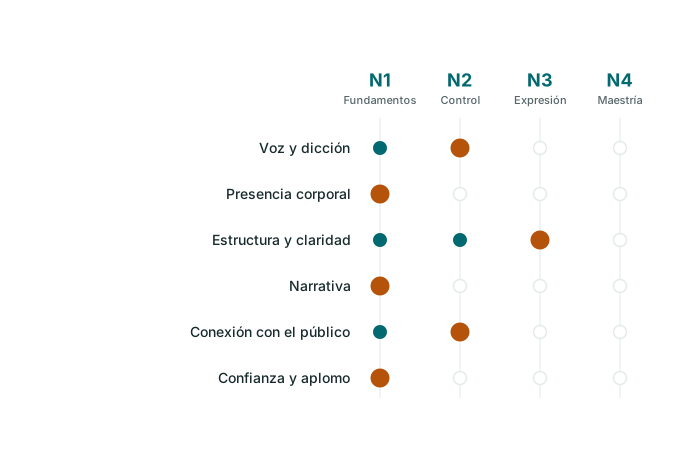
A matrix of the six Gestoa skill areas across four mastery levels — L1 Foundation to L4 Mastery — with each skill's current level highlighted.

The 6 skill areas, in detail

Voice Delivery

Voice Delivery covers pace, clarity, filler words, volume, and pitch variation — everything that determines whether your voice projects authority and keeps your audience engaged.

Filler words above 8/minute signal nervousness and erode credibility, regardless of how good your content is. A pace above 185 WPM makes you impossible to follow.

  • Words per minute (WPM) — target range 130–175
  • Filler words per minute (um, uh, like, basically, you know)
  • Volume consistency (relative dB variance across the session)
  • Pitch variation range (Hz) — signals engagement and emphasis
  • Strategic pause duration — silence as a rhetorical tool
  1. L1

    Fillers > 8/min, WPM > 185 or < 100. Unaware of habits.

  2. L2

    Fillers < 5/min, WPM in the 130–175 range. Reliable delivery.

  3. L3

    Fillers < 2/min, deliberate pauses, pitch variation active.

  4. L4

    Fillers < 1/min, voice adapts to content and audience tone.

Example AI feedback
Your pace held well in the first 90 seconds (148 WPM) but spiked to 197 WPM after the investor interruption at 2:14. That's your stress signal. You also used "basically" 4 times in 20 seconds — a new personal pattern to watch. Run the Pace Control drill next.

Body Presence

Body Presence covers eye contact, posture, and gesture — the physical signals that tell an audience you're grounded and in command, measured on-device so the footage never leaves your browser.

When your gaze drops below 50% for long stretches, an audience reads it as uncertainty before they hear a single weak argument.

  • Gaze percentage (time looking toward camera/audience)
  • Posture deviation score
  • Gesture frequency and amplitude
  1. L1

    Gaze drifts, closed posture, gestures absent or distracting.

  2. L2

    Gaze above 50%, neutral grounded posture held.

  3. L3

    Eye contact sustained through key moments; gestures reinforce points.

  4. L4

    Presence adapts to the room; stillness and movement are deliberate.

Example AI feedback
Your eye contact averaged 64% — strong — but dropped to 38% for the 12 seconds you spent on the numbers slide. That's exactly where you most need the room with you. Run the Eye Contact drill on your data section.

Structure & Clarity

Structure & Clarity is about logical flow and signposting: whether a listener can follow your argument and extract your thesis without effort.

If an AI can't extract your thesis from the first 20 seconds, a distracted human in the third row certainly can't.

  • Thesis extractability (can the main claim be isolated?)
  • Section detection (are distinct parts signposted?)
  • Signposting-phrase frequency
  1. L1

    Thesis buried or absent; sections blur together.

  2. L2

    Thesis stated early; main sections detectable.

  3. L3

    Clean signposting; each section earns its place.

  4. L4

    Structure feels inevitable — the audience always knows where they are.

Example AI feedback
Your thesis was extractable at 0:18 — good. But the AI couldn't separate your second and third points; they ran together with no signpost. Add one transition phrase and re-run the Signposting Chain drill.

Storytelling & Persuasion

Storytelling & Persuasion measures whether your narrative lands: a complete arc, concrete detail, and an emotional pull that makes the stakes felt.

Most speakers explain. Few make an audience feel the problem before the solution is named — and that gap is what decides whether you're remembered.

  • S.O.A.R. arc completeness (Situation, Obstacle, Action, Result)
  • Concrete-to-abstract language ratio
  • Emotional-arc shape across the talk
  1. L1

    Abstract claims, no story, flat emotional line.

  2. L2

    A recognisable arc with at least one concrete detail.

  3. L3

    Complete S.O.A.R. arc; concrete detail carries the point.

  4. L4

    Story and argument are inseparable; the arc serves the message.

Example AI feedback
Your opening story had a clear Situation and Obstacle, but no Result — it trailed off into a product feature. Land the Result first, then name the product. Run the Problem Story 60s drill.

Audience Connection

Audience Connection measures whether the talk feels like a dialogue: inclusive language, rhetorical questions, and a sense of speaking with the room rather than at it.

A talk that's all "I" and no "you" or "we" leaves a room feeling lectured. The pronouns are measurable, and so is the fix.

  • You/We versus I ratio
  • Rhetorical-question frequency
  • Direct-address markers
  1. L1

    Self-focused language; no direct address.

  2. L2

    Some inclusive language; occasional direct address.

  3. L3

    Deliberate You/We framing; questions invite the room in.

  4. L4

    The audience feels addressed personally throughout.

Example AI feedback
You said "I" 23 times and "you/we" only 4 times — the talk read as a monologue. One rhetorical question in your opening would flip the framing. Run the You Pivot drill.

Confidence & Composure

Confidence & Composure measures stability under pressure: what happens to your delivery the moment you're interrupted, challenged, or blank.

Anyone can sound composed reading a script. The skill that separates speakers is recovering in two seconds, not freezing for eight.

  • WPM delta — calm baseline vs. challenged segments
  • Filler spike under pressure
  • Blank-moment recovery speed (seconds)
  1. L1

    Pressure causes WPM spikes, filler bursts, long freezes.

  2. L2

    Recovers within a few seconds; delivery stays intelligible.

  3. L3

    Absorbs a challenge and comes back on-message.

  4. L4

    Composure is invisible; pressure barely moves the metrics.

Example AI feedback
After the hostile question at 3:10 your WPM jumped from 142 to 201 and you used "um" 4 times in 8 seconds — then recovered in 5.2 seconds. The recovery is the win; the spike is the work. Run the Interruption Recovery drill.

Tools like Orai and Speeko score pace and fillers; Gestoa measures 25 metrics across 6 skill areas — voice, body presence, structure, storytelling, audience connection, and composure — and advances your level only when the thresholds hold for 3 consecutive sessions, not when you decide you're ready.

Two ways to practise

Quick Drill

2–3 minutes

One micro-skill, one pass threshold. Repeat until you hit it. "60 seconds, zero fillers" — retry until you're below 3.

Practice Session

20 minutes

A full run at a real scenario with live cues during and a structured report after. How long it runs, how much pressure gets added — a countdown, interruptions, a tough question — and which of the 6 skill areas are pushed hardest all follow from the scenario you pick and the level you're working at.

Practise the moments that matter

General5 min
Status Update Meeting

Structure & Clarity, Voice Delivery

  • Leads with the conclusion, then supports it
  • Situation–Complication–Resolution structure detected
  • WPM and filler rate within range
Example AI feedback
You buried the headline at 1:40 — the update read as a build-up, not a conclusion-first brief. Open with the decision you need. Strong filler control throughout (1.2/min).
Founders5–8 min
5-Minute Investor Pitch + Hostile Q&A

Storytelling & Confidence (weighted), all 6 scored

  • Problem story present in the first 60 seconds
  • All 5 pitch sections detected and connected
  • Composure score across the injected interruption
Example AI feedback
Strong problem story — the customer detail made the pain tangible. At the 3-minute interruption your WPM jumped from 142 to 201. Run the Conviction Drill next.
Young Professional2–3 min
Behavioural Interview Answer (STAR)

Structure & Clarity, Confidence & Composure (weighted)

  • STAR structure detected: Situation, Task, Action, Result
  • Background kept under 40% of the answer
  • Pace and filler hold steady through the Action section
Example AI feedback
Your Result landed well — closing on the 20% time saving is exactly what an interviewer remembers. But the answer front-loaded the setup: most of it was Situation and Task before you reached what you actually did. Trim the background and get to the Action sooner. Run the STAR Trim drill.
Enterprise3 min/seat
Group Baseline Assessment

All 6 — baseline only

  • Per-seat radar profile across all 6 areas
  • Group-level weakest-skill heatmap
  • Pre/post comparison anchor for the programme
Example AI feedback
Group baseline complete: 22 of 25 seats scored L1 in Confidence & Composure — the clear starting focus for this batch.

See your own numbers in 3 minutes

Your first session is free — a full, measured baseline across all 6 skill areas.

Frequently asked questions